
AI is a bubble and investors shouldn’t fight it, Ohsung Kwon and his colleagues at Wells Fargo recommended in a note to clients this week. Their logic? The amount of capital expenditure (capex) going into AI is simply too big to ignore and investors should ride that momentum.
The closure of the Strait of Hormuz, rising oil prices, and increasing inflation complicate the picture for other companies and their stocks, Kwon says. But in tech, “AI keeps bubbling,” he wrote.
“There will be a breaking point, but until then, a closed strait actually fuels the AI bubble trade, in our view. You can’t own anything but AI—that’s how a bubble forms. We expect limited downside until either growth slows, core inflation meaningfully accelerates, or if the war evolves into a hot war,” he told clients on May 12. “Don’t fight the tape. Own AI. Sentiment is euphoric, but given that the rally has been driven by strong EPS momentum, we don’t see much downside risk yet.”
Echoes of ‘railway mania’
Kwon drew a comparison with the “railway mania” bubble of the mid-1800s, when railroad companies raised vast sums to build train networks before their over-valued stocks collapsed.
The bank estimates that Q1 2026 AI capex totalled $174 billion, up 72.8% from the year before. Capex “drove 42% of 1Q GDP growth and was 2.4% of total US GDP,” Kwon said.
While massive, that is still below the levels seen in the first computer boom and the dot-com bubble that followed in 1999-2000. “It’s expected to surpass those peaks by 4Q26, reaching 3%, based on consensus Hyperscaler capex. At some point, other parts of the economy will have to grow to support capex. Railroad investments peaked at ~3% in the 1850s.”
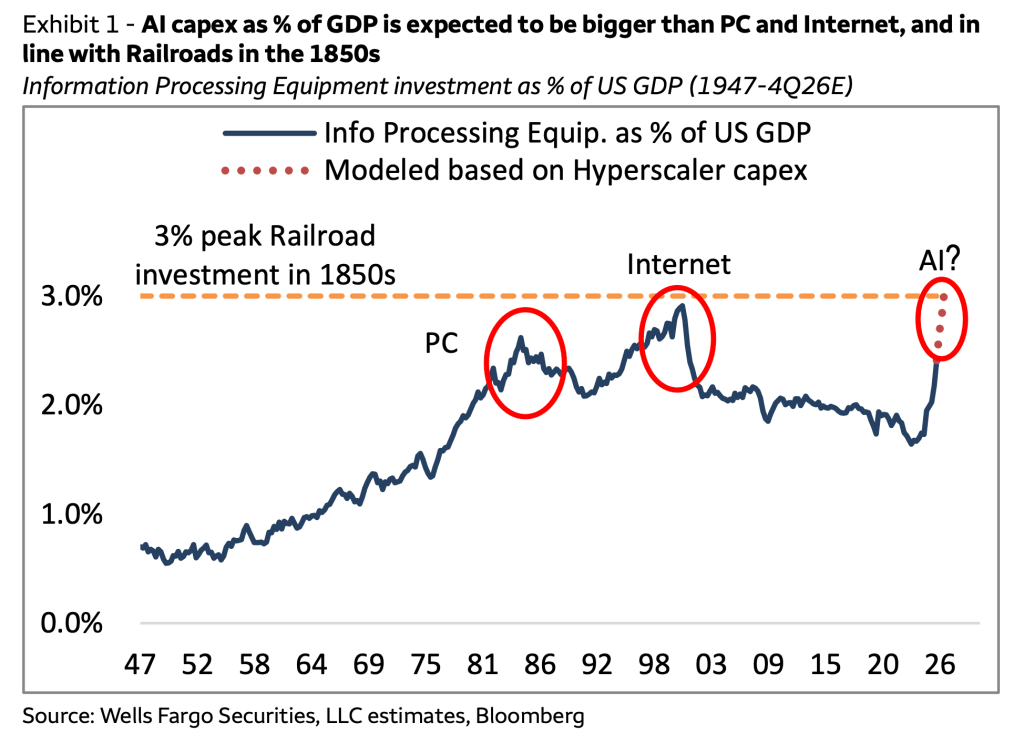
Total AI capex from the hyperscaler companies—Oracle, Meta, Alphabet, Amazon, Microsoft, and so on—was $400 billion in 2025 and is expected to reach $700 billion in 2026, according to Goldman Sachs analysts Joseph Briggs and Sarah Dong. They see capex peaking at 2% of U.S. GDP, a little lower than Wells Fargo’s projection.
Nothing to fear here
Kwon—who has made this call before—isn’t alone in this view.
At Wedbush, Dan Ives and his colleagues published a note yesterday saying that “the fears surrounding Oracle remain overdone.” That’s a reference to Oracle’s debt; it has raised the most debt among the hyperscalers to fund its AI buildout plans.
Oracle has more than enough “remaining performance obligations” (RPOs) to fund that spending, Ives said. RPOs are future contracts that have not yet been booked as revenue because they could be cancelled.
“The company’s capex-to-RPO ratio [is] ~9.0% compared to the peer average of ~33.6%,” Ives wrote. “The company’s capex profile was being driven by a massive backlog and long-dated customer commitments, which remains the right framework in our view. Oracle has $553.0 billion in RPO, as this is a company building against visible demand. The market has focused heavily on near-term free cash flow pressure and the optics of elevated spending, but we continue to think that view is too narrow. Oracle is spending because it has to meet demand that is already there.”
Ark Invest: still cheaper than 1999
And at Ark Invest, Cathie Wood’s team published a note recently arguing that although capex was rising to dot-com levels, the price-to-earnings ratios of tech stocks remained far below the valuations in that bubble:
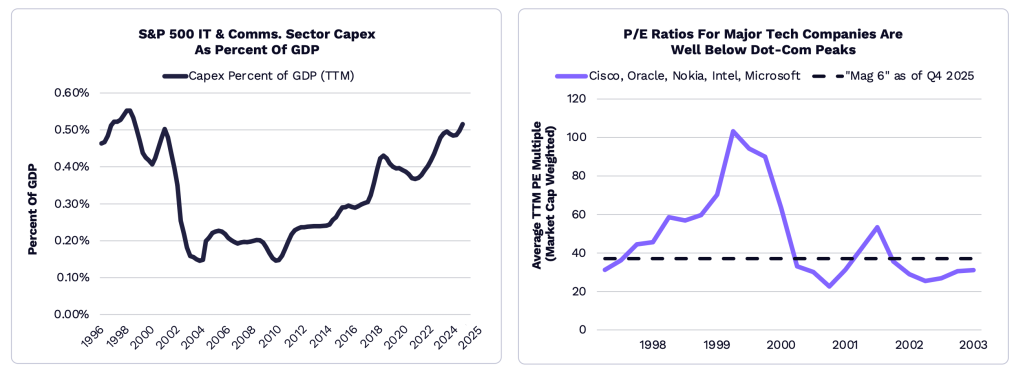
In other words: even the bubble-watchers think there’s room to inflate.
This story was originally featured on Fortune.com
Recent Comments