
Fifty years ago, four in 10 American families survived on a single income. Now, the days of the single-income household are long gone.
For the first time in U.S. history, the majority of all heterosexual households have two full-time, working parents. Now, both parents in more than half (52%) of heterosexual couples with kids under 18 hold full-time jobs, according to a Pew Research analysis of 2025 U.S. Census Bureau data.
As a result, the stay-at-home parent is also on the decline. About a fourth of families are made up of a dad who works full-time and a mom who is unemployed. Pew found that just 6% of moms work full-time while their male partner isn’t employed, or works part-time. That’s twice as many moms as 50 years ago.
Another 14% of working parents aren’t married or don’t live with a partner.
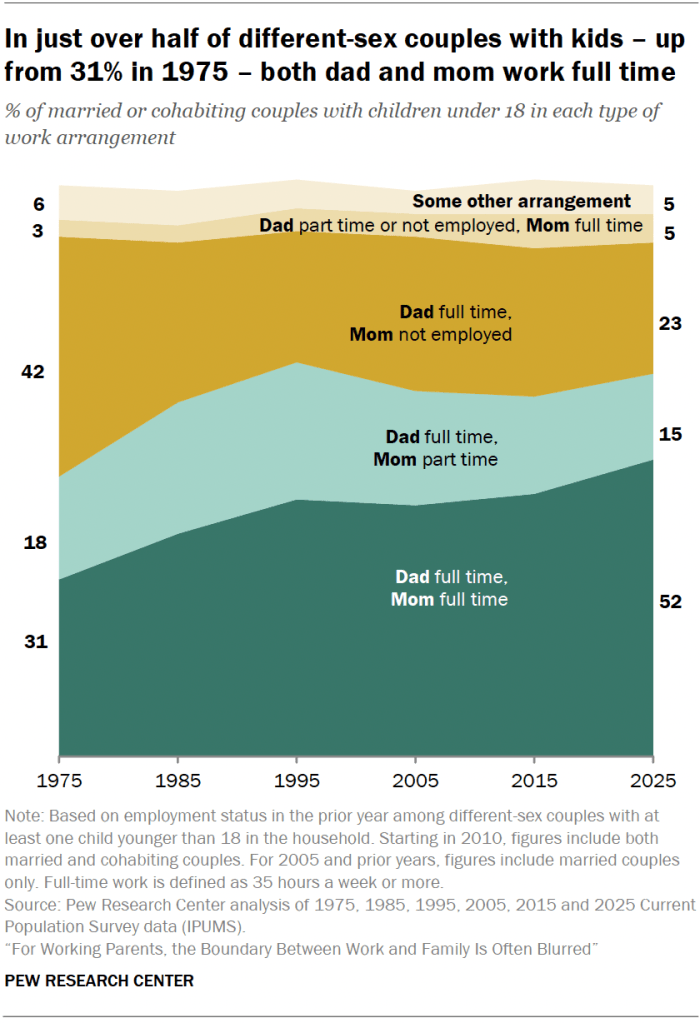
The split between dads and moms working isn’t the same across all racial backgrounds. Six in 10 partnered Black mothers work full-time, down from 64% in 2000. Meanwhile, the share of working Asian and white moms has increased over time. Now, 54% of Asian moms and 52% of white moms work full-time. About 45% Asian and white moms worked full-time 25 years ago.
Hispanic families are an outlier: the percentage of full-time, double-income families has held steady over the last 25 years at about 44%. Another third of Hispanic mothers aren’t employed, the highest rate of unemployment across racial groups.
Educational background also shapes how moms work. About seven in 10 partnered mothers with an advanced degree work full-time. Over half of moms with a bachelor’s degree work full-time, compared to 43% of moms with less education.
Families where both parents work at least part-time see more financial benefits than families where just the father works, Pew found, even as all parents surveyed said their family’s work arrangement has not had a positive or negative effect on their career advancement.
More employed, more involved
The increase of households depending on two full-time incomes comes as simply surviving life feels out of reach for more and more Americans. Homeownership, stable employment, or even just feeding your kids are becoming more unattainable as high inflation and even higher interest rates take up a larger percentage of people’s incomes. Concerns over the cost of living have skyrocketed since the pandemic. Now, nearly a third of Americans report high living costs as their main financial problem, compared to just 3% in 2020.
It comes down to the higher costs of living. Raising a child costs more than $300,000 over the first 18 years of their life, LendingTree recently found, compared to $165,630 about 25 years ago. A two-child household must earn more than $400,000 a year for childcare to be considered affordable by federal guidelines. Half of Americans say they have just enough money to maintain their standard of living, and nearly a fifth say they’re falling behind.
On top of making ends meet, parents today are expected to spend more time with their children, adding pressure to strike the perfect work-life balance. More than half of parents who work full-time said they struggle to balance work and family responsibilities, Pew found.
“Working moms today are spending more time with their kids than stay-at-home moms when we were kids,” Wharton School economist Corinne Low previously told Fortune.
The burden of child and household care still falls overwhelmingly on women. Even when a wife outearns her husband, she still does almost twice as much cooking and cleaning as her partner, according to Low, which Pew’s findings echoed. Nearly two-thirds of caregiving is done by women, and if American women were paid for all their unpaid labor, it would be worth $683 billion, according to the National Partnership for Women & Families.
This story was originally featured on Fortune.com
Recent Comments